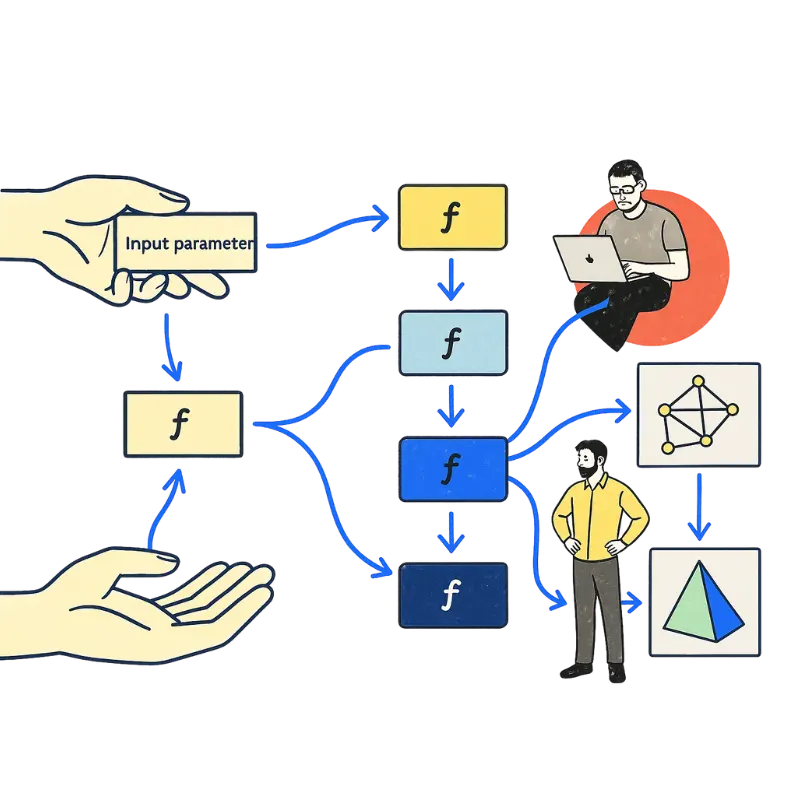
Functional programming focuses on composing pure functions, avoiding shared state, and immutability. Key mechanisms include first-class and higher-order functions. Emphasizes declarative over imperative code — describing what to do, not how to do it. JavaScript methods like map , filter , and reduce align well with functional concepts.
Benefits include clearer, reusable code; challenges include potential over-abstraction. Especially relevant in frameworks like React, which embrace declarative patterns.
Today, we'll explore functional programming, a paradigm that gained popularity among developers, especially due to its effective integration within React. While it may seem popular now, functional programming isn't new - it's been used extensively in academic contexts for decades. React's rise in popularity has brought several foundational functional concepts into mainstream development. In this blog post, we’ll cover:
Essential mechanisms like first-class and higher-order functions Declarative versus imperative programming styles Advantages and potential challenges of using functional programming Practical examples of functional programming concepts in JavaScript For hands-on practice with these concepts, explore CSX Coding Challenges .
Functional programming is built around three core principles:
Function Composition: Combining simple functions into more complex ones - like assembling LEGO blocks into larger, useful structures.
Avoiding Shared State: Functions operate independently, relying only on their inputs, much like workers completing tasks without needing to share tools.
Avoiding Data Mutation: Variables are immutable, similar to writing with permanent ink - you don’t alter what's already written but instead create something new.
Adopting these principles enhances code reuse, significantly reduces bugs related to shared state, and simplifies debugging processes. Functional programming depends on two powerful concepts:
First-Class Functions: Functions treated as values - meaning they can be assigned to variables, passed as arguments, and returned from other functions.
Higher-Order Functions: Functions that accept other functions as arguments or return them, adding layers of flexibility to code structure. Advantages and Challenges of Functional Programming While functional programming offers powerful benefits, it also comes with challenges:
Excessive abstraction can make code less readable. To address this, maintain balance by writing small, focused functions, providing clear comments, and using descriptive naming. Functional programming may be unfamiliar to developers accustomed to object-oriented paradigms.
Understanding the difference between these approaches helps leverage functional programming effectively: Explicitly details each step of how tasks are executed.
Focuses on what the result should be, simplifying and clarifying code, making it especially useful in React where declarative code eases component logic and facilitates easy refactoring. Not relying on external variables (similar to using only ingredients you brought yourself).
Avoiding side effects (like keeping your kitchen clean while cooking). Being deterministic (always producing the same output given the same inputs, like following a consistent recipe). JavaScript provides several built-in methods that align perfectly with functional programming principles:
Executes a provided function once for each array element without mutating the array. Creates a new array containing elements that meet a specific condition. Transforms each array element, resulting in a new array. Combines array elements into a single value, often used for aggregating or summarizing data.
These methods test array elements against conditions: every: Checks if all elements meet the condition. some: Checks if at least one element meets the condition. Functional programming improves code reusability, clarity, and maintainability. Thoughtfully balance functional patterns with readability to ensure code effectiveness.
Leverage JavaScript’s first-class and higher-order functions to maximize the benefits of functional programming.
Adopting these functional concepts can significantly enhance your JavaScript development, making your applications easier to understand, maintain, and scale.