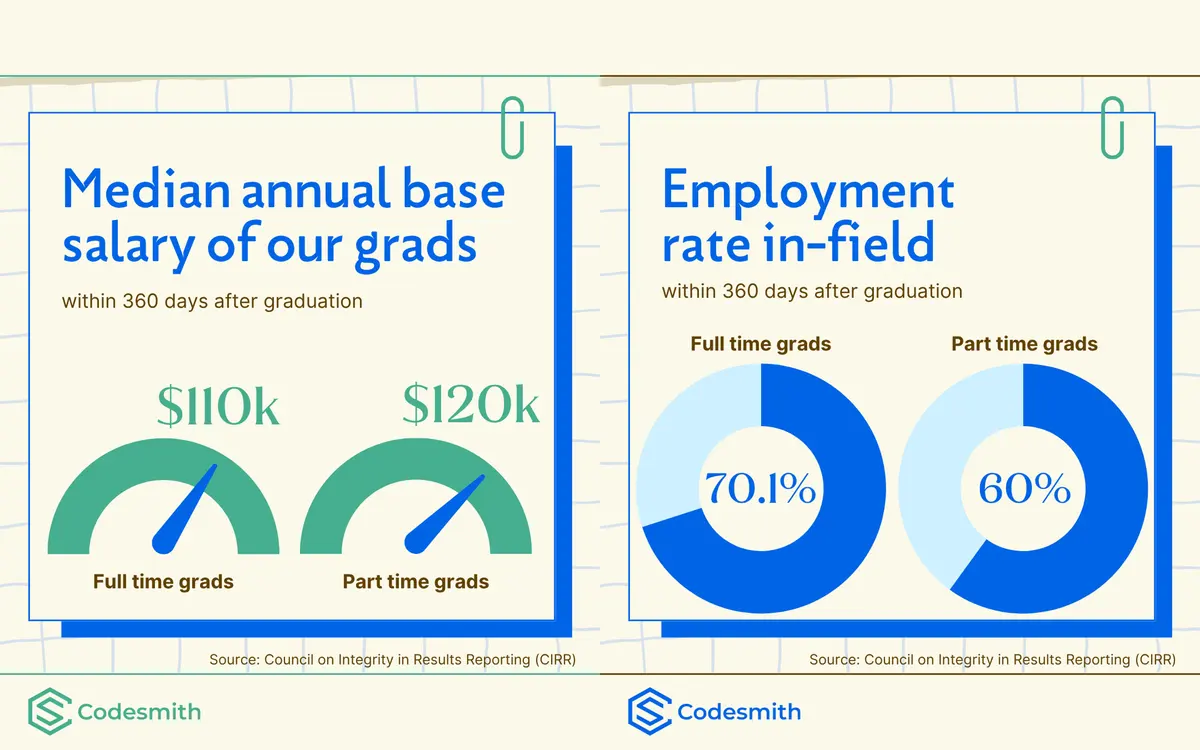
In a tech landscape that has seen more headlines about layoffs, hiring freezes, and economic contraction than career growth, it might be easy to assume that the door to a software engineering career is closing. But this year’s newly released 2023–24 CIRR Outcomes Report on Codesmith’s grads tells a very different story.
The data is in, and it’s a compelling message for anyone wondering whether it’s still possible to break into tech: Yes. Not only is it possible—it’s happening every day.
This year’s outcomes have just been verified and published by the Council on Integrity in Results Reporting (CIRR) , the only independent, third-party organization that publishes outcomes data in tech education. CIRR's standards are rigorous, fully transparent, and audited by independent CPAs to ensure accuracy.
These numbers reflect high employment and salary outcomes along with a consistency in the quality of roles Codesmith graduates are landing—with the majority taking on mid-level or higher responsibilities in engineering-focused roles.
"As someone who's been in tech for over a decade, I can tell you this: great software engineers have always been hard to find," says Alina Vasile, Codesmith's Director of Growth & Product.
"Even in a market flooded with talent, what companies truly need are engineers who can think critically, look under the hood of today’s evolving tech stack, and turn complexity into real business results. AI is accelerating productivity, but it’s the human engineers who know how to harness that power critically and creatively that will shape the future. That’s why I’m so passionate about what we’re doing at Codesmith."
Full-Time vs. Part-Time: Different Paths, Strong Results
Behind every data point is a story. One that resonates powerfully is that of Mateo Lopez-Castillo , a Codesmith graduate who joined the Full-Time Remote Immersive after previously attending another bootcamp that left him feeling underprepared for the job market.
Mateo’s journey wasn’t easy. After finishing the program in 2023 and completing a Codesmith fellowship, he spent a year in the job search, submitting over 1,000 applications. It was a grind that tested his patience and resilience.
Eventually, Mateo landed a coveted role at Meta—a one-year contract-to-hire engineering position. His story exemplifies the kind of long-term support and real-world readiness Codesmith is committed to.
His Open Source Project (OSP), a technically ambitious WebAssembly integration toolkit, became a strong talking point in his interviews. But more than the project itself, it was Mateo's ability to explain it, dissect trade-offs, and discuss real engineering workflows that impressed recruiters.
Mateo’s story is just one among many, and it shows that success in this space doesn’t always follow a linear timeline. It rewards depth, persistence, and the right educational foundation.
It’s tempting to compare today’s numbers to those from the hiring boom of 2020–2021, when tech roles were more abundant and offers often arrived before bootcamp grads finished their program. But we live in a different tech climate now. The bar is higher. The process takes longer. Companies want engineers who can learn fast, think strategically, and contribute beyond just writing code.
And that’s where Codesmith’s model shines. It focuses on deep learning, not just skill acquisition. Most bootcamps focus on quickly covering basics. Codesmith raises the bar with: A rigorous full stack computer science curriculum Open Source Projects that simulate real engineering work
Immersive environments that prioritize technical communication
In an industry where some education providers cherry-pick results or hide behind vague statistics, Codesmith remains fully committed to CIRR standards. That means: ✅ 100% of students are accounted for (not just those who opt-in) ✅ All roles are verified, either through grad reports or LinkedIn validation
✅Audit processes are independently reviewed by professional accounting firms Transparency is one of our guiding principles. That’s why we want to clearly outline what is and isn’t included in our data: ✅ 55.8% of full-time grads and 46.9% of part-time grads reported their salaries and roles directly to us.
✅ For the remaining grads, we used LinkedIn to verify employment where available—ensuring companies and roles were legitimate and aligned with in-field definitions.
🚫 Open Source Projects (OSPs), even if featured on LinkedIn as experience, we filtered them out and only focused on verifiable companies.
🚫 Fellows, part-time contractors, or grads employed by Codesmith itself (only 4 long-term instructors were included in the total of 1,152 grads in 2023). This data reflects real external hiring outcomes. No shortcuts. No cherry-picking. Just the truth. Looking ahead: The future of tech education
What’s clear is that the old models are falling short. Traditional computer science degrees are costly and slow to adapt. First-generation bootcamps, many of which focused on surface-level skills, are now collapsing. The future of tech education isn’t either/or—it’s both/and.
That’s the foundation Codesmith is building on. And these outcomes prove that it’s working. And not only is it possible to break into tech in today’s market, it’s possible to thrive.